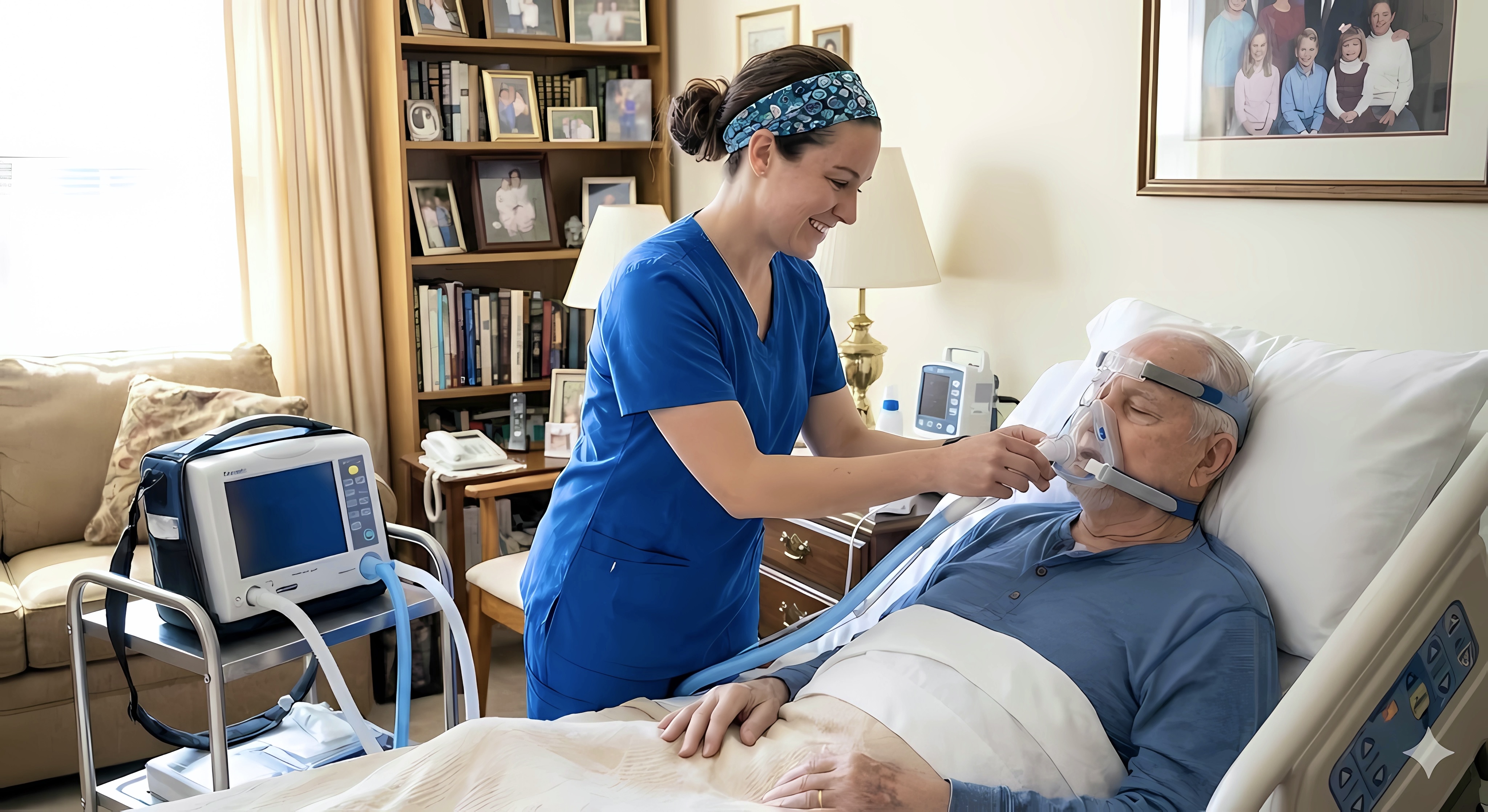
Hire experienced ICU nurses for ventilator-dependent patients, tracheostomy care, and complex respiratory support. We handle the equipment so you can focus on your loved one.
Trusted by 50+ Toronto families this year.
Licensed with College of Nurses of Ontario for ventilator and high-acuity care.
When your loved one needs more than basic home care, you need a registered nurse who understands invasive ventilation, tracheostomy protocols, and high-acuity monitoring. We're trained to read the numbers, adjust the settings, and recognize when something isn't right.
We provide specialized support for ventilator-dependent patients including invasive ventilation management, tracheostomy hygiene, and airway clearance. Our nurses handle BiPAP, CPAP, and mechanical ventilator settings with the same precision you'd expect in an ICU. When the alarms go off at 2 AM, you'll have someone who knows exactly what to check first.
We manage:
Trach care and suctioning, oxygen titration, cuff pressure checks, ventilator troubleshooting, emergency protocols for equipment failure.
Transitioning from hospital to home is terrifying when your loved one still needs intensive monitoring. We bridge that gap with registered nurses experienced in complex continuing care and high-acuity patient management. We're comfortable with PICC lines, central venous catheters, wound vacs, chest tubes, and the medication regimens that come with multi-system illness.
Specialized in:
ALS home nursing support, spinal cord injury care, long-term ventilation (LTV) programs, Transitional Home Ventilation Program support.
Hospital discharge planners throw around terms like "tidal volumes" and "PEEP settings" without explaining what they mean for your dad's breathing at 3 AM. We translate the medical jargon into language that makes sense. Before you sign off on a care plan you don't understand, talk to someone who's been in the ICU and knows what questions to ask.
We help with:
Discharge planning review, equipment setup verification, family training for basic airway management, coordination with respiratory therapy.
Wound care, IV therapy, post-surgical monitoring, chronic disease management, palliative nursing, pediatric care, and full geriatric assessments. If your family member needs clinical nursing care at home, the answer is almost always yes, we can do that.
Surgical wounds, VAC therapy, pressure injuries, ostomy.
IV antibiotics, PICC lines, central line care, TPN.
Comfort-focused nursing, symptom control, hospice support.
Postpartum, newborn, pediatric chronic illness.
Stroke, dementia, Parkinson's, seizure, MS, TBI.
Insulin, anticoagulants, pain meds, polypharmacy.
When a patient leaves a hospital after a serious illness or surgery, the first few weeks at home are the highest-risk period. The monitoring, the assessments, the quick interventions that kept them stable in the hospital don't stop being necessary just because they've been discharged. Toronto ProRN fills that gap. We bring the clinical vigilance of a critical care unit into the home environment, giving families the confidence that comes from having someone with genuine medical expertise watching over their loved one.
The services below are organized by clinical category. Toronto ProRN is a private-pay service only. Families pay privately, out of pocket, for our services. We do not bill or accept insurance. We'll work with you and your physician to ensure the correct documentation is in place from the start.
For patients transitioning home from a hospital stay who still require clinical-level monitoring.
Clinical assessment of vital signs, incision sites, drainage, and neurological status following any surgical procedure, with direct physician communication when findings warrant.
Structured home care that replicates step-down unit monitoring for patients who are medically stable but not yet safe without skilled nursing oversight.
Home monitoring after heart attack, cardiac surgery, or arrhythmia treatment, including cardiac rhythm awareness, fluid balance, and activity progression.
Urgent bedside evaluation when a patient's condition changes acutely at home. Our nurses assess, stabilize, and determine whether hospital transfer is necessary.
Specialized care for patients who have been discharged following an ICU admission, where the risk of rapid deterioration remains elevated in the first weeks at home.
Clinical preparation and patient education before scheduled surgeries or procedures, including medication adjustments, fasting guidance, and assessment documentation.
Hospital-grade vascular access and infusion management delivered at home.
Home administration of intravenous antibiotics for conditions requiring prolonged courses, eliminating daily hospital visits while maintaining clinical-grade delivery and monitoring.
Professional insertion-site care, line flushing, dressing changes, and patency assessment for peripherally inserted central catheters to prevent infection and occlusion.
Management and maintenance of central lines including port-a-cath access and care for patients receiving ongoing IV therapies at home.
Home intravenous hydration management for patients with dehydration, electrolyte imbalances, or conditions requiring supplemental fluid support outside of hospital.
Management of intravenous nutritional support for patients who can't meet their needs through oral or enteral feeding, including line care, monitoring, and complication prevention.
Skilled nursing observation and adverse reaction monitoring during and after blood product administration for eligible patients receiving transfusions at home.
Advanced wound management using ICU-standard sterile technique.
Post-operative wound assessment and sterile dressing changes for all surgical site types, with infection monitoring and direct reporting to the operating surgeon or GP.
Management of vacuum-assisted wound closure devices for complex or non-healing wounds, including canister changes, seal integrity checks, and wound bed assessment.
Comprehensive pressure injury management from staging and debridement support through advanced wound dressings and repositioning protocols for bedbound patients.
Specialized lower extremity wound care for diabetic patients, including ulcer staging, offloading guidance, infection monitoring, and vascular assessment.
Colostomy, ileostomy, and urostomy appliance management, peristomal skin assessment, and patient education for newly formed and established stomas.
Home care for partial-thickness burns and post-grafting wound management, including pain-conscious dressing protocols and infection surveillance.
Ongoing clinical oversight for patients living with complex or multiple long-term conditions.
Comprehensive Type 1 and Type 2 diabetes care including continuous glucose monitoring, insulin pump management, hypoglycemia protocols, and HbA1c tracking coordination.
Daily weight monitoring, fluid balance assessment, edema grading, and early detection of decompensation to prevent hospital readmission in congestive heart failure patients.
Regular blood pressure monitoring, medication compliance assessment, hypertensive urgency recognition, and physician liaison for patients with poorly controlled or secondary hypertension.
Oxygen saturation monitoring, inhaler technique assessment, nebulizer treatments, and early exacerbation recognition for patients with COPD, emphysema, or chronic bronchitis.
Fluid balance monitoring, dietary compliance support, laboratory result tracking, and access site care for patients on dialysis or approaching end-stage renal disease.
Home-based asthma action plan monitoring, inhaler technique, peak flow tracking, trigger identification, and emergency response planning for high-risk patients.
Skilled nursing for conditions affecting the brain, spinal cord, and nervous system.
Post-stroke neurological monitoring, dysphagia assessment, mobility support, and coordination with physiotherapy and speech therapy for patients recovering at home.
Safe home management of behavioral and psychological symptoms of dementia, wandering prevention, cognitive assessment, and family coping support.
Medication timing management, fall risk reduction, swallowing safety assessment, and motor symptom monitoring for patients with Parkinson's disease living at home.
Seizure observation and documentation, rescue medication administration, post-ictal monitoring, and safety protocol implementation for patients with epilepsy or other seizure conditions.
Symptom monitoring, relapse identification, injection therapy administration, fatigue management support, and coordination with the neurology team for MS patients at home.
Cognitive and physical monitoring for patients in home-based TBI rehabilitation, including neuro-checks, behavioral assessment, and family education on managing symptoms.
Clinical oversight of tubes, devices, and respiratory support systems in the home setting.
Tracheostomy tube care, inner cannula cleaning, stoma site management, suctioning, and caregiver training for patients requiring airway management at home.
Ventilator circuit management, alarm response, breathing parameter monitoring, and emergency weaning support for ventilator-dependent patients living at home.
Home oxygen saturation monitoring, flow rate assessment, concentrator troubleshooting, and management of patients on supplemental oxygen for any diagnosis.
Nasogastric and PEG/gastrostomy tube care, enteral feeding management, tube placement verification, and nutritional monitoring for patients who can't feed orally.
Foley and suprapubic catheter insertion, maintenance, and removal along with infection prevention, urinary output monitoring, and caregiver education.
Compliance monitoring, mask fit assessment, and tolerance support for patients using non-invasive positive pressure ventilation for sleep apnea or respiratory insufficiency.
Clinical medication oversight for patients with complex or high-risk drug regimens.
Full clinical review of all current medications, identification of duplications, interactions, and contraindications, with a formal report provided to the prescribing physician.
Administration of subcutaneous and intramuscular injections including insulin, low molecular weight heparin, and biologic agents for patients who can't self-administer.
Structured pain assessment, opioid safety monitoring, side effect management, and liaison with the prescribing team for patients on complex analgesic regimens at home.
Clinical oversight for elderly or multi-diagnosis patients on five or more medications, with dosette box preparation, schedule management, and compliance monitoring.
INR result interpretation support, warfarin dosing coordination with the prescriber, and bleeding risk assessment for patients on long-term blood thinners.
Compliance monitoring, side effect assessment, and early symptom recognition for patients on antipsychotic, mood stabilizer, or antidepressant therapy living at home.
Expert nursing support for patients living with cancer or entering end-of-life care.
Skilled nursing support for cancer patients receiving treatment at home, including symptom management, fatigue assessment, nutritional monitoring, and infection risk reduction.
Home assessment for nausea, neutropenia risk, mucositis, peripheral neuropathy, and other chemotherapy side effects, with a clear escalation pathway to the oncology team.
Skilled implanted port access, needle management, flushing, dressing, and infection prevention for cancer patients with indwelling vascular access devices.
Expert symptom control, comfort-focused care planning, and family support for patients with life-limiting illness who wish to remain at home as long as possible.
End-of-life nursing care focused on dignity, pain relief, and family presence. Our nurses coordinate with the broader hospice team to support the patient and family through this time.
Advanced pain assessment using validated tools, opioid titration support in coordination with the prescriber, and management of dyspnea, nausea, and agitation at end of life.
Clinical nursing for new mothers, newborns, and medically complex children at home.
Home monitoring for pregnancies complicated by pre-eclampsia, gestational diabetes, multiple gestation, or other conditions requiring regular clinical assessment before delivery.
Post-delivery nursing assessment of mother and newborn including wound care, hemorrhage monitoring, blood pressure checks, and infant feeding support in the first weeks at home.
Full newborn nursing assessment including jaundice monitoring, weight checks, umbilical cord care, and feeding evaluation for newborns transitioning home from hospital.
Home nursing for children with asthma, diabetes, epilepsy, congenital heart disease, or other chronic conditions requiring skilled nursing monitoring and family education.
Specialized home nursing for children with complex medical needs including technology dependence, feeding tube management, and tracheostomy care.
Clinical home visits for premature or NICU-graduate infants requiring continued monitoring of growth, feeding, neurological development, and respiratory status after discharge.
Comprehensive assessments, specimen collection, elder care, and the education that keeps patients and families safe between visits.
Complete systematic physical assessment including cardiovascular, respiratory, neurological, abdominal, and skin evaluation with a formal written report provided to the patient's physician.
Validated fall risk scoring, home hazard identification, mobility assessment, and implementation of evidence-based fall prevention strategies for elderly or high-risk patients.
Home blood draws, urinalysis, wound culture collection, and other specimen collection services, eliminating the need for frail or mobility-limited patients to travel to a clinic.
Comprehensive elder care nursing including dehydration prevention, skin integrity monitoring, cognitive assessment, nutritional evaluation, and polypharmacy review for aging patients.
Structured education for family members on medication administration, wound care techniques, disease recognition, emergency response, and safe patient handling in the home.
Professional clinical relief for family caregivers who are managing a high-acuity patient at home. Our nurses step in so you can rest, with the confidence that your loved one is in expert hands.
Our ICU-trained nurses manage almost any clinical need within the Ontario Registered Nurse scope of practice. Tell us what you need and we'll confirm whether we can provide it.
Ask About Your Specific NeedWe provide private duty nursing services throughout Toronto and surrounding regions. Whether you're in downtown Toronto or the surrounding municipalities, we'll match you with an experienced ICU nurse who can get to your home quickly.
Yorkville, Rosedale, Forest Hill, Bridle Path, Oakville.
Concierge-level ICU nursing for Toronto's premier neighborhoods and Oakville.
Downtown, Midtown, The Annex, Yorkville, Rosedale, Forest Hill, Casa Loma, Old Toronto.
Expert ventilator, wound, IV, and palliative nursing for central Toronto families.
Willowdale, Bayview Village, Don Mills, Lawrence Park, Bridle Path.
Private ICU nurses for complex medical and geriatric needs across North York.
Agincourt, Malvern, Highland Creek, West Hill, Woburn.
Registered nurses for tracheostomy, wound care, and chronic disease in Scarborough.
Mimico, Islington, Kingsway, Humber Bay, New Toronto.
24-hour ventilator support and high-acuity home nursing in Etobicoke.
Port Credit, Streetsville, Meadowvale, Erin Mills, Downtown Brampton, Oakville.
Private duty nursing across Peel and Halton Regions.
Markham, Richmond Hill, Vaughan, Thornhill, Aurora, Newmarket.
Concierge nursing for complex respiratory and post-surgical care in York Region.
Not sure if we cover your area? We serve the entire GTA including Durham Region, Halton Region, and premium neighborhoods throughout Toronto.
Contact us to confirm service availabilityToronto ProRN was founded by JoAnne Andrea Gomez, RN, a Registered Nurse with 27+ years of clinical experience, including 12+ years in the Trauma-Neuro ICU at St. Michael's Hospital and earlier years in the Medical-Surgical ICU at Toronto Western Hospital / UHN. She holds a Critical Care Nursing Certificate from Humber College, a nursing diploma from George Brown College, and a dual Bachelor of Arts in Psychology and English from the University of Nebraska. She's also a published author of two books available on Amazon: Burnout to Balance: Your 8-Step Guide to Thriving in a Messy Workplace and Stronger Than You Think: A Guide for Teens Overcoming Anxiety and Childhood Trauma. She writes regularly about healthcare and nursing at medium.com/@msjag416.
When a loved one gets discharged from ICU with a tracheostomy, a ventilator, or complex medication needs, families assume Personal Support Workers can handle it. They can't. PSWs aren't trained to troubleshoot ventilator alarms, manage invasive airways, or interpret the subtle signs that oxygen saturation is dropping before the monitor catches it. That's when families panic and end up back in the emergency room at 2 AM because they don't know if the high-pressure alarm means the trach is plugged or if Dad just coughed.
We fill that gap with Registered Nurses who've worked in critical care units across Canada. These aren't new grads learning on your loved one. They're experienced ICU nurses who know what a normal chest rise looks like on mechanical ventilation, who can suction a trach without causing a vasovagal response, and who understand when it's safe to wean oxygen versus when you need to call respiratory therapy. They've managed patients on BiPAP, CPAP, invasive ventilation, and high-flow nasal cannula. They know the difference between position-dependent desaturation and true respiratory distress.
For families managing long-term ventilation, post-ICU recovery, complex wound care, IV antibiotic therapy, palliative care at home, or chronic disease management, you need someone who speaks the same language as your respirologist, your oncologist, or your discharge planner. We translate the medical terminology into decisions you can make with confidence. We also work with ALS patients, spinal cord injuries, and anyone requiring complex continuing care at home who can't afford to have an amateur managing their clinical needs.
Important: Toronto ProRN is a private-pay service only. Families pay privately, out of pocket, for our services. OHIP does not cover private duty nursing. We do not bill or accept insurance. We encourage all clients to verify nursing credentials through the official CNO Registry. Every nurse we refer is licensed and authorized to practice in Ontario without restrictions. You're not just hiring a warm body with a certificate. You're hiring someone who can keep your loved one safe when everything goes wrong at 3 AM.
JoAnne Andrea Gomez, RN — Registered Nurse, College of Nurses of Ontario. 27+ years clinical experience in Trauma-Neuro ICU and Medical-Surgical ICU. Founder of ProRN Inc. Author of Burnout to Balance and Stronger Than You Think. ICH GCP E6(R3) certified.
An ICU nurse has specialized training in critical care including mechanical ventilation, hemodynamic monitoring, and life-support equipment management. They've worked in Intensive Care Units where patients are on ventilators, vasopressors, and continuous telemetry. A regular home care RN might have excellent wound care skills but won't know how to troubleshoot a ventilator alarm or recognize early respiratory decompensation. For ventilator-dependent patients or high-acuity needs, you need someone who's managed similar patients in a hospital ICU setting.
No. Toronto ProRN is a private-pay service only. OHIP doesn't cover private duty nursing. Families pay privately, out of pocket, for our services. We do not bill or accept insurance. This keeps the arrangement simple, fast, and fully focused on your loved one's clinical care.
Our nurses provide a full scope of clinical services that fall within the Registered Nurse scope of practice in Ontario. This includes ventilator and tracheostomy care, IV therapy, PICC and central line management, complex wound and ostomy care, post-surgical monitoring, chronic disease management, stroke and neurological recovery, medication administration and injections, palliative and hospice nursing, maternal and newborn care, and comprehensive geriatric assessments. See our full scope section above for the complete list. If your family member needs clinical nursing care at home, the answer is almost always yes, we can do that.
For urgent, high-acuity needs like ventilator management, tracheostomy support, or hospital discharge coverage within the Greater Toronto Area, we aim to match you with a qualified RN within 24 to 48 hours. If your loved one is being discharged from hospital soon, contact us as early as possible so we can arrange coverage before discharge day. Non-urgent consultations or staffing for lower-acuity needs can typically be arranged within three to five business days.
Yes. The first few weeks at home after a serious illness or surgery are the highest-risk period. Our ICU-trained nurses provide structured home monitoring that replicates the step-down unit: vital sign tracking, wound and incision assessment, pain and medication oversight, and early detection of complications. We communicate directly with your surgeon, oncologist, or GP when findings warrant escalation.
Our hourly rates cover the nurse's time, clinical expertise, and travel within the GTA. Rates vary based on the complexity of care required (ventilator management costs more than medication administration), shift timing (overnight shifts have premium rates), and notice period. We'll provide transparent pricing during your initial consultation. Additional costs might include specialized equipment rental, supplies, or family training sessions. There are no hidden fees and we don't charge markups on medical supplies.
Safety is paramount. Every registered nurse we refer is in good standing with the College of Nurses of Ontario. Use the CNO registry to confirm the license status of any nursing professional before they enter your home.
Tell us about your loved one's needs. We respond within 1 hour for urgent ventilator care, post-surgical coverage, and high-acuity nursing requests in the Toronto area.
Toronto, North York, Scarborough, Etobicoke, Mississauga, Oakville, Markham, Richmond Hill, Vaughan, Brampton. Specialized service in Yorkville, Rosedale, Forest Hill, and Bridle Path.
Toronto ProRN is a private-pay service only. Not covered by OHIP. We do not bill or accept insurance. Families pay privately for our nursing services.
"Finding a private ICU nurse who understood my father's ventilator settings was impossible until we found this team. They're professional, calm under stress, and incredibly skilled with complex respiratory equipment."
— Sarah J., Etobicoke
Fill out this form to send us a secure email about your in-home nursing needs. All fields are required.
Last Updated:
At Toronto ProRN, we're committed to protecting the privacy and confidentiality of your personal health information. We adhere strictly to the Personal Health Information Protection Act (PHIPA) of Ontario and all relevant Canadian privacy laws.
We collect only the information necessary to provide safe, competent nursing care. This includes your name, contact details, and relevant medical history necessary for triage and care planning.
Agreement to Terms
By accessing our website and requesting our services, you agree to be bound by these Terms of Service. If you don't agree, please don't use our services. Toronto ProRN is a private-pay service. We are not covered by OHIP.
Not Medical Advice
The content on this website is for informational purposes only and isn't intended to be a substitute for professional medical advice, diagnosis, or treatment.